Maya M.h★★★★★
…I trust Dr. Iman’s judgment on what my skin needs. The staff is really friendly, respectful. I highly recommend paying a visit.Google review · 7DMC Al Barsha


Skin tags, warts and moles are common skin growths that many people want removed because they catch on clothes or jewellery, bleed when rubbed, or simply bother them. At 7 Dimensions Medical Center (7DMC) our dermatology doctors examine every growth first, then remove skin tags and warts in a short clinic visit and assess moles carefully before deciding how to treat them. We offer this at our Jumeirah (Umm Suqeim 3) and Al Barsha (Arjan) branches.
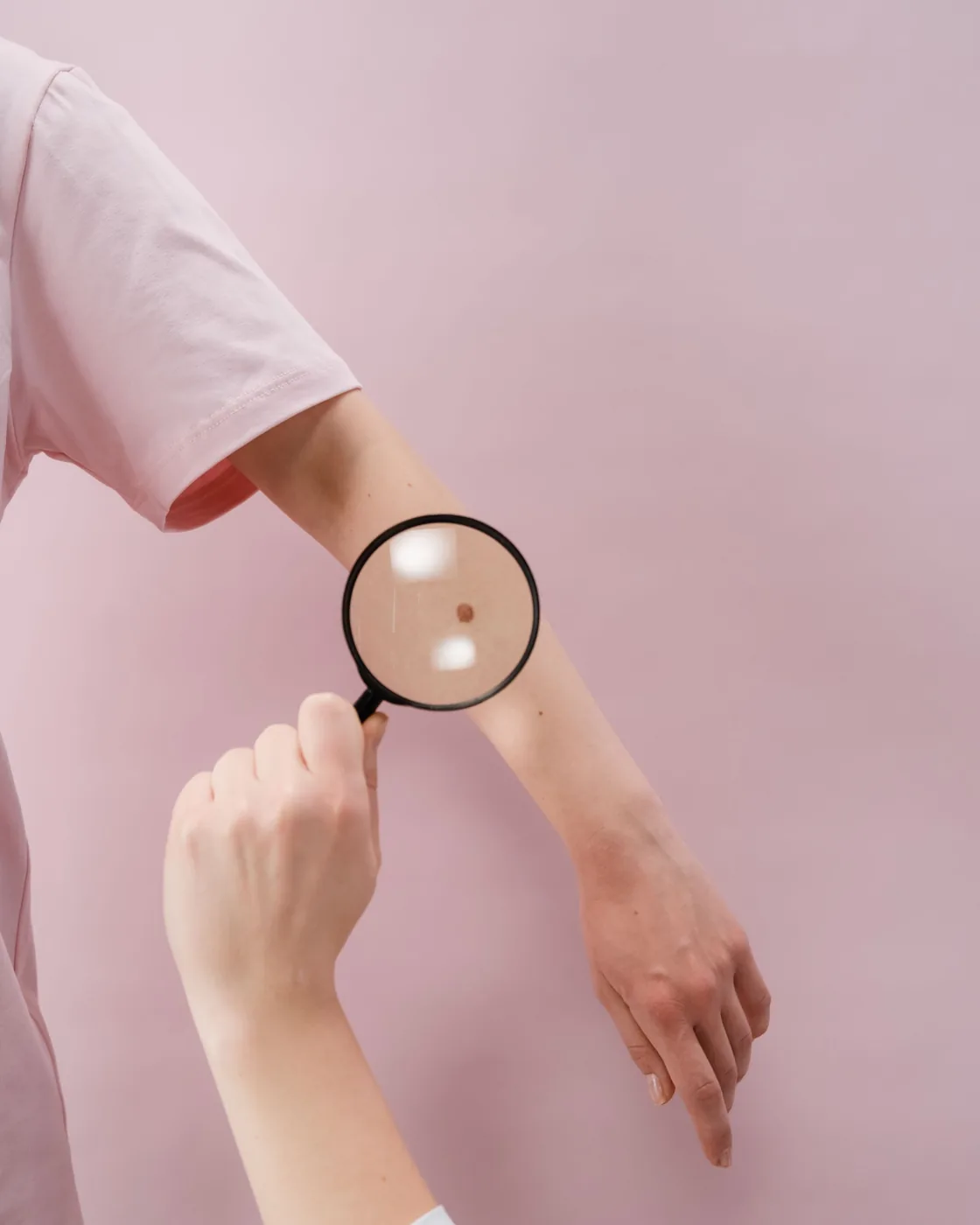
It is the removal of small, usually harmless skin growths by a doctor, using a method chosen for the type, size and site of each growth.
| Method | What it involves | Often used for |
|---|---|---|
| Cryotherapy | The growth is frozen with liquid nitrogen and falls off over 1 to 3 weeks | Small skin tags, warts and verrucas |
| Electrocautery | A fine electrical tip seals and removes the growth | Small skin tags and some flat growths |
| Snip excision | The tag is numbed and snipped off at the base | Larger skin tags on a stalk |
| Shave excision | A raised mole is shaved flush with the skin under local anaesthetic and usually sent for testing | Raised moles that look harmless |
| Surgical excision | The mole is cut out whole and the skin closed with stitches | Moles that need full laboratory testing |
A mole is never removed just for appearance without being looked at first. Your doctor examines it with a dermatoscope (a skin magnifier) and asks whether it has changed. Signs that need a closer look include the ABCDE changes: an Asymmetrical shape, an irregular Border, more than one Colour, a Diameter larger than about 6 mm, or a mole that is Evolving (growing, changing, itching or bleeding). If a mole looks unusual, it may need a biopsy: part or all of it is removed and sent to a laboratory. Your doctor explains the result and the next step, which may include a referral if specialist care is needed. In many cases the biopsy can be done at the same appointment.
It suits adults and children (with a parent present) who have:
It may not be suitable, or may need to wait, if you:
…I trust Dr. Iman’s judgment on what my skin needs. The staff is really friendly, respectful. I highly recommend paying a visit.Google review · 7DMC Al Barsha
… I’m also a regular patient of Dr. Iman, who has always provided outstanding care as well, during my dermatology sessions. The team here truly goes above and beyond to make you feel comfortable and looked after.Google review · 7DMC Al Barsha
Dr Iman is very professional, she’s doesn’t push for any unnecessary procedure , lovely and friendly environment.Google review · 7DMC Al Barsha
Talk to our team at Jumeirah or Al Barsha. We will answer your questions and help you choose the right next step.
Snipped or excised growths are usually gone after one visit, and the area heals over 1 to 2 weeks, leaving a small mark that fades over months. Frozen growths form a blister or scab and drop off within 1 to 3 weeks. Warts can be stubborn and often need 2 to 4 treatments a few weeks apart. Skin tags can appear again in new places, because the tendency to form them remains. Results vary from person to person.
Removal is minor, but it carries risks. You may have redness, soreness, swelling or a blister for a few days. Every removal leaves a mark, usually a small flat scar, sometimes lighter or darker than the skin around it. Infection is uncommon. Warts can come back, and new skin tags can form. A shaved mole can partly grow back or leave some colour. Rarely, a raised (keloid) scar develops in people prone to them.
The cost of skin tag and mole removal in Dubai usually ranges from AED 300 to AED 2,500, depending on the type and number of growths, the removal method, any laboratory testing and the clinic. Typical ranges: Skin tag removal, one or a few tags, AED 300 to AED 1,500; Wart treatment (cryotherapy), per session, AED 300 to AED 1,200; Mole removal, per mole, AED 700 to AED 2,500. These are typical market prices across Dubai clinics, not a 7DMC price list. At 7DMC, your exact price is confirmed at your consultation, before any treatment.
The medical name for a skin tag is an acrochordon, and removal is usually done by cryotherapy (freezing), electrocautery or snip excision. Mole removal is called shave excision or surgical excision.
Freezing stings for a few seconds. For snipping, shaving or excision, a local anaesthetic numbs the area first, so you usually feel the small injection and then only pressure.
Often, yes, if your doctor is happy that it looks harmless, and removed moles are usually sent to a laboratory to confirm what they are. Suspicious moles are assessed first and may need a biopsy before the full plan is decided.
Watch for the ABCDE signs: asymmetry, an irregular border, several colours, a size over about 6 mm, or any change, itching or bleeding. Any of these is a reason to have it checked by a doctor.
Removal for appearance is usually not covered. Removal or testing of a mole for medical reasons may be, depending on your policy. Our team can check with your insurer before treatment.
7DMC offers skin tag, wart and mole removal at two branches: Jumeirah, in Umm Suqeim 3 opposite Jumeirah Beach Hotel, and Al Barsha, in Arjan, Al Barsha South.
